Why the Fourth Revolution is the Era of the Exponential, and How this Changes Everything

The Fourth Revolution is the era of the exponential – whereas the Industrial Age was the era of linearity. And that changes everything in the way we live our life:
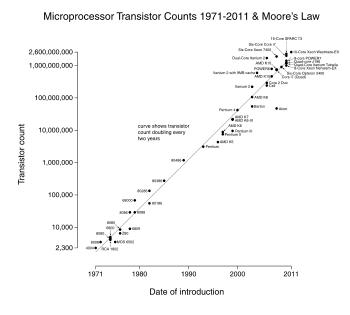
Moore's Law 1971-2011

Moore’s Law 1971-2011 (from Wikipedia)

  • the complexity of the products we use every day increases exponentially. For example the Moore’s law states that microprocessors density on chips doubles every 2 years; and that’s the case for many other products we use every day without realizing it;
  • Successful companies and services grow exponentially, soon dwarfing existing players (the revenue of Apple was multiplied by 11 in 10 years… not to mention the even more exponential growth of the Facebooks of the world)

In the Industrial Age, things were more linear. It was easier to extrapolate the future from the past. Of course a factor is that things go faster today so that it is easier to watch exponential change in action. Yet the Moore’s law rate did not change in the past 40 years or so. Microprocessors’s density still double in the same number of years. So speed of change is not the discriminant. The fact that things grow visibly exponentially and have higher ceilings than before makes the Fourth Revolution different.


story of rice on chessboard

Are you sure you want to get to the end of the chessboard?

The problem is that we are not geared to feel intuitively the power of the exponential. It is very difficult to seize how fast it can grow. Do you remember the tale of the wise man that told the King who wanted to thank him: “only put a grain of rice on the first square of a chess board, then on the next square put two, then on the next square put four, then double for each square until the end of the chess board…” The King never realized that at the end of the 64 squares the quantity of rice needed would vastly exceed his available supply – and the world’s supply and even more!

This explains why so many people today have difficulty understanding what happens in the world. In their linear Industrial Age mindset, they can’t grab how the exponential is changing our lives faster and deeper than ever before.

Are you ready for a world full of exponential change?

Thanks to Mitch Joel and his post on “The Era of Exponential Marketing” – a specific area where most people also don’t realize we are in for exponential growth of product sales- for the inspiration.

The great picture of the rice on the checkboard is by Paul Starkey on Flickr


LinkedInEmailShare
This entry was posted in Collaborative Age, Collaborative Age, Collaborative Age value production system, data availability, Fourth Revolution, Fourth Revolution ignition, Humankind Revolutions, Industrial Age. Bookmark the permalink.
  • Benoit

    Jeremie, I should say yes and no ; the real matter is that a short linked world (as we are building it) is giving to every thing a print related not to its main size but to the number of consequences (impacts) at the second, third and so on degrees. It looks exponential but it is also naturally limited. Great but not infinite.
    The lesson for me is only that we are living among systems, each of them more complex. To keep efficient in this world needs to collaborate because impulse by one is quickly overwhelmed.
    Let’s be happy with that !

    • http://www.thefourthrevolution.org Jeremie Averous

      Hi Benoit, thanks for your deep insights. I fully agree with you that the exponential is limited by the size of the world… which is big enough so that it still looks like an unfathomable exponential? I like your idea of collaboration being a great way to overcome complexity. I need to have some thoughts about that… possibly a new blog post idea! Thanks

    • Jerome

      Jeremie, Benoit

      This discussion connects for me to the fractal logic. I understand Mandelbrot fractals to speak about large scale orders, where astonishing similarity can exist in a large frame of scale.
      Does it mean it is infinite? No and Mandelbrot says so: if a rope is self similar to itself in several/ large number of Russian dolls, if zooming on a coast (e.g. Brittany) looks like a coast, if we can cut a cauliflower several times and still have a cauliflower, this is not true to the macro and micro infinity.
      It just happens that matter and many reality phenomena can be self similar across a very wide range of scale. But all has a limit.
      Somehow the rule of diminishing returns would apply. There are always what can by named “externalities”: items that are not taken into account in the net result — due to complexity, business focus, limited space and time assumptions.

      I believe collaboration plays a role, even if it has limits in the sense that it requires dedicated skills that are not common today and it could be naive to assume it could solve by itself any issue.

      • http://www.thefourthrevolution.org Jeremie Averous

        Hi Jerome, thanks for your great insights too. I fully agree with your views that somehow we will reach some diminishing returns – but the new economy makes it further away as it uses less natural resources. Practically I believe that we’ll see exponential developments followed by big crisis (negative black swans) so that the ride will be tough. Still I am so amazed that it is so difficult to get an intuition of exponential development!

    • http://www.thefourthrevolution.org Jeremie Averous

      Hi Benoit, thanks for your deep insights. I fully agree with you that the exponential is limited by the size of the world… which is big enough so that it still looks like an unfathomable exponential? I like your idea of collaboration being a great way to overcome complexity. I need to have some thoughts about that… possibly a new blog post idea! Thanks
